Friday, December 4, 2009

Peace at the Heart of the World (and Chaos & Connections behind the scenes) – Day 2 of the Parliament of the World’s Religions (Fri., Dec. 4 / 09)

Today, for me, was one of those days of the niggling complications that always threaten to take over participation in an event

Anna and I got to the Conference Center late today. We had to clear up some hotel issues for Raul. Thanks to only knowing very late if he could attend, I could only get him a room for the 2nd – 5th and the 7th – 10th. We had no idea where he would be for the night of the 5th and 6th. We managed to arrange another room at the hotel for those two days, but had to find Yoland Trevino to confirm, since she had offered to put him up of her roommates agreed.

For me and Anna, this Parliament has so far been about long walks and lots of calls, all trying to make various connections. Even just finding someone else in the same building can be an adventure when the Conference Center is a third of a mile long!

After working out the room, we then went off to find Raul, et al., to make sure that he was set up with translation for the day and to try to confirm whether or not he needed the weekend room.

These things being settled, we went to the EarthSpirit booth at 2:00pm for a run-through of today’s “Peace at the Heart of the World” ceremony, organized by Andras and Deirdre from EarthSpirit, and including other EarthSpirit folks, Angie Buchanan & Drake Spaeth, Anna & me, and some local Pagans we met on site. While we waited for everyone to gather, Anna and I spoke with three Witches from Queensland – Linda Ward, Belinda David, and Helen Gilmour – all part of a group called Pagan Hearth which is involved in interfaith (and intrafaith) work.

At one point, the script read-through got bogged down into questions of direction of circle flow and which quarters were which, given the differences of Traditions and Hemispheres, but we quickly agreed that the best rule to follow was that each person would perform their ritual part the way they usually do and we would all just go with the flow. As they say here, “No worries!”

There was enough time between our read-through and the ceremony for folks to grab a bite and change into ritual garb. Anna and I went off in search of a place to change.

On the way, we ran into Andras, who had been waylaid by a woman who was complaining to him in his role as a Trustee, about some aspect of the Parliament. Andras was listening politely while trying to explain that he had little or no control over whatever it was that was the problem. Just then, Charles Gibbs, Director of the URI, walked by. As he paused to talk to us, I took the opportunity to introduce him to Andras and we all commiserated over the behind-the-scenes hassles of putting on interfaith events.

Anna and I moved on. She found a women’s room readily enough. For me, things were a little more complicated…

Pagan women have it easy in interfaith work when it comes to ritual attire. There are a lot of women’s clothes these days that look great in a meeting, at a fine restaurant, and in a ritual. And if they DO have to change, women’s rooms are much more likely to accommodate serving as a quickie changing room. Women’s restrooms usually have purse-hooks or shelves upon which to place one’s belongings while attending to one’s appearance.

There is very little that Pagan men can wear to a meeting that will also look good in a ritual. Coat & tie? Forget it! Men in most of the other religious traditions either throw something over what they are wearing or have a specific garb that they wear all the time. Pagan men usually need a place to change their clothes and men’s rooms just don’t cut it. Almost all men’s rooms are made for men to come in, do one thing, and leave. They usually don’t have hooks to hang things, surfaces to place things, or even places to stand where you don’t run the risk of your robe dangling into a urinal. This convention center was no exception and was actually worse than most venues, with floors you really wouldn’t want to set a cloth or paper bag down upon. This is just one more little logistical complication that can be a part of interfaith work.

I asked the many Parliament volunteers if there was someplace – a closet would be fine – where I could change my clothes for a ceremony. No one had a clue and they were all on their walkie-talkies asking everyone else. Finally, one person said that a group had just finished doing Naga Chants in one of the meeting rooms which had a backstage dressing room and maybe I could use that. She led me through a maze of passages, and institutional kitchens, doubling back when we encountered locked doors to which she didn’t have keys, until we found a man wrapped in a sort of sarong covered with indigenous snake designs wearing a tall feathered hat, decorated with boar tusks, who said that he was locked out of the dressing room, where all his stuff was. All the doors around here lock automatically and the person who had let him in originally was nowhere to be found.

Leaving him to his inverse of my situation while calling for backup, my guide led me to a women’s dressing room which was available. While Anna waited in the outer room with some women who suddenly appeared to prepare for a dance performance, I tried to perform the simple act of changing into ritual robes. Anna knocked on the door to say that the women were changing too, so I should knock before coming out. So far, so good.

Now… some of you know that I have been recovering from a surgical accident a little over two years ago that left me with somewhat limited control of my left arm and hand (and a LOT of pain). This usually isn’t to much of an impairment in interfaith, but I had rolled up the sleeves of my shirt due to the heat, and the rolls were just tight enough to not slide over my elbows, so when I tried to let my shirt fall off my back I suddenly found myself with my arms pinned by the rolled up sleeves and not enough motor control to get my arms close enough to each other to pull my way out. I was wriggling around in an effective straight-jacket, wondering how to explain this through the door to the small crowd of women in the next room without looking like a total fool.

Eventually, with enough wriggling, I was able to get free and make the change. Anna and I headed off to room 202, the planned ritual site, where Deirdre informed us that Andras had found a suitable outdoor site just outside the main lobby.

As we made our way there through the lobby in our robes, we were constantly stopped by friends and acquaintances who commented on our fancy garb, asked about what we were doing, and wanted to get their photos taken with us.

About 15 ritual performers, including an Earthspirit harpist, were gathered under the eaves of the Convention Center. We were soon joined by about 30 more people following Deirdre from Room 202.

The ceremony was about and hour long and included many beautiful chants, as EarthSpirit rites always do. Andras explained to all that the ceremony would be in three sections, addressing: Peace in Our Hearts, Peace Between Our Hearts, Peace at the Heart of the World.

The first part was led by Sue Arthen and included the circle casting and setup and focused on each of us opening our hearts to the voices and influences of the sacred creation around us – to Sky, Sea, the Green Ones, Air, Stone, Fire, the Animal Beings, Water, the Ancestors, the fullness of the Earth.

Angie led the second part and introduced Anna and me. We performed the Waters of the World ceremony that I have done at many interfaith events. (The text and list of Waters were posted previously.) Instead of handing out the Waters (since we didn’t know how many to expect and didn’t want to bring scads of unused vials across the Pacific twice), we invited the participants to dip their fingers in the waters and anoint their own hearts.

The third section was led by Deirdre and involved the passing of balls of twine around the circle and back to the center to weave a web. We each ended up holding several strands of twine, which were then cut, leaving each of us with several short lengths to braid together.

The ceremony was lovely, effectively engendering a sense of peace, and everyone seemed to enjoy it a lot. Raul attended with Rachael, and this was the first full-on Wiccan ceremony he had seen. He was favorably impressed. I introduced him to Andras and he, Andras, and Rachael chatted away in Spanish (which I can understand). Andras laughed at the “Don Don” story, and suggested that I become a Bishop so I could be “Don Don Don”. Raul thought this was hysterical. (If anyone wants to hear the “Don Don” story, say so and I’ll post it later.) I expect that next time I go to Latin America, all my friends will be calling me “Don Don Don”.

Shortly after the rite, folks started gathering to go to “Communities Night”, in which local representatives of each faith tradition host a dinner for visiting members of the same faith. Anna planned to attend the Pagan night, but I was unsure and wanted to make sure that Raul was a) somewhere he wanted to be, and b) somewhere with a translator.

I had promised to go to a brief meeting with Yoland and Charles at 6:00pm to talk about the URI’s new Wisdom & Vision Council (of former URI Trustees) which I co-coordinate. Anna and I walked half the length of the Center to find Charles and Yoland, planning to meet quickly and catch a cab to the Pagan night. Rachael and Raul went with us, hoping Yoland would have some idea of whether Raul should go to the Indigenous night (which was just an Aboriginal museum visit) or come with us to the Pagans.

As things seem to go at interfaith conferences – but more so at this one, it seems – it took a while to get everyone together and the group kept growing. Marites Africa, URI Regionak Coordinator for the Pacific, joined us. Then George Armstrong, emeritus URI Global Council Trustee, and his wife. Then Swami Agnivesh, new URI GC Trustee for Asia, and his assistant Alison. The group grew as it moved, slowly making its way out the East door of the complex, where we encountered a number of Atheists protesting the Parliament with signs like “Let Reason Decide!” and “$100,000 prize if you can prove your religion is true!” and “Don’t just believe!”

While Alison called around on her cell, trying to find a restaurant that could accommodate all of us, the rest of us engaged the Atheists. They were stunned that all of the religious folks had been nice to them, that many of our group agreed with almost all of their views on science and reason, and that we have atheists in our own interfaith organizations. There was a lot of posing for pictures with the Atheists in their anti-religion T-shirts and me in my Wiccan robes and Swami Agnivesh in his brilliant orange garb.

Alison reported that she had found us a vegetarian restaurant, but this meant walking all the way back to the other end of the Center to catch taxis outside the Hilton and let Rachael drop off her scooter.

Along the way, we picked up Uncle Max, one of the leading Aboriginal elders at this event. He was fascinated by Rachael’s scooter and wanted to drive it. She gave him some quick lessons and off he went, driving loops around us as we made the long walk back.

Eventually, getting later and later, we made it to the taxi stand and waited for several cabs to carry our swollen group of 11. While we waited, Jake Swamp, former Chief of the Akwesasne Mohawk nation, walked out of the hotel, spotted Raul, and asked to be introduced. It turns out that he is organizing something similar to the Initiativa Indigena Global and there is interest in cooperating. How fortuitous.

The taxis arrived. Alison explained to four drivers where we were all going. Anna left for Pagan Community night and I went with the URI crew, since in snatches of conversation, Charles, Yoland, and I were still having our meeting about the Wisdom & Vision Council.

Almost 40 minutes later, as our taxi slowed to figure out where this restaurant was, someone mentioned for the first time that the name of the place was “Nirvana”. Hmm… Vegetarian. Nirvana. Oh no. “Is this an Indian restaurant?” I asked. No one in our cab knew. When we got out and found Alison, I asked her. Yes, it was Indian.

I am terminally allergic to an unknown ingredient in Indian food. Alison offered to move to another restaurant, but most of us were already seated and this seemed logistically impractical, if not impossible. I could have just not eaten, but that would have just bummed everyone else out for their meal. Standing there, still in my white and purple robes, in a suburb of Melbourne, I had to turn around and catch a cab home to my hotel. Fortunately, the 24-hour McDonald’s next door was open after I had gotten back and changed clothes.

I hope they had a great dinner. Anna had a great time, as she reported when she got back from Pagan night. I’m sure she’ll write something to CoG’s lists about it, or maybe something I can post here.

Once again, it is late. Tomorrow will be a busy day. The program listing just for tomorrow is 45 pages long. There are many fascinating programs, several by friends of mine. On top of that, the Australian Pagans have moved one of their major conferences – Magic Happens! – from Sydney to Melbourne just to coincide with the Parliament, and that is all day tomorrow. Anna and I MIGHT be doing our “Images of Our History” presentation there, but we’re still not sure. And I still have to finish the meeting with Yoland and Charles. And finish prepping my own presentation for Sunday. It promises to be another chaotic, complicated day. I hope I can keep that Peace at the Heart of the World with me throughout the day.

Blessed Be,
Don Frew
National Interfaith Representative

Indigenous Perspectives on Conflict Resolution panel

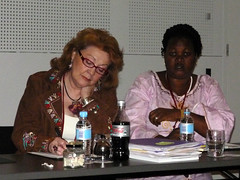
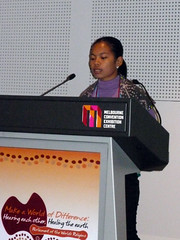
Friday I went to a panel on Indigenous Perspectives on Conflict Resolution with Tonya Gonnella Frichner of the Onondaga Nation (USA) Lilybeth Sulutan of the Bagobo Tagabawa (Phillipines) and Margaret Lokawua of the Karimjong (Uganda). Frichner&Lokawua.jpg They each had 15 minutes to talk about the methods of conflict resolution in their region, followed by discussion. Ms. Frichner talked about how hard it was to manage the Mohawk Nation when it crosses the USA/Canada border and the recent set-to with Canada arming their border guards. Lilybeth_Sulutan.jpg Ms. Sulutan had a presentation on the history of her people and the levels of censure for wrongdoing and how such things were decided by mediators and tribal councils. Ms. Lokawaua spoke about the Lord's Resistance Army and child soldiers and various problems of resource ownership (the Nile's water rights belonging to Egypt rather than to the upstream nations, indigenous landrights at odds with government eminent domain) and other problems facing them. She believes that religious institutions have a role to play in bringing all the disparate groups together. It was clear that conflict in Uganda was many-faceted and, as with the Onondaga, many players/jurisdictions must be brought together. There were no great revelations, but the depth of the problem was definitely brought to light.

Rowan Fairgrove
National Interfaith Representative

Musings on the language of Interfaith dialogue

Each morning of the Parliament begins with offerings of religious observances by many different traditions. Friday morning I attended the Yoruba Religious Observance offered by Baba Wande Abimbola of Ifa School in Nigeria.

I find myself thinking about his words and I wanted to share my musings. He said several times things like "You don't understand what we mean by sacrifice", "Sacrifice is very important in Ifa", "Sacrifice is the language through which we speak to the Orisha". He then talked about wearing yellow-orange clothes and giving yellow-orange fruit to Oshun. It made me want to look up sacrifice and see what it really means because I admit that what I am hearing I would call sacra (permanent things dedicated to the Gods such as special clothing) and offerings (ephemeral things given for the use of the Gods such a food). [Though I see the dictionary doesn't have sacra in it at all, it must be a term of art from my Umbanda practice.]

For me, sacrifice would mean giving something very precious to me to the Gods, rather than just a normal offering, which offering is indeed a "language" for speaking to the Gods. Merriam Webster says that the word Sacrifice comes from Middle English, from Anglo-French, from Latin sacrificium, from sacr-, sacer + facere to make. So sacrifice is literally to make something sacred, but the first definition is 1 : an act of offering to a deity something precious; especially : the killing of a victim on an altar. So the Baba has probably run into people who hear the word sacrifice and think of human or animal sacrifice. Going to the definition of Offerings 1 a : the act of one who offers b : something offered; especially : a sacrifice ceremonially offered as a part of worship c : a contribution to the support of a church. So really sacrifice/offering are quite interchangeable it seems.

In interfaith I am always torn between moderating my language to something palatable to my hearer and using the terms of art or religious phrases that I actually use. So sometimes I have said "We are all children of one Mother" instead of "We all come from the Goddess". But sometimes I have said Goddess. It really depends on my audience. I think that Don's stages of interfaith dialogue are very true. I don't remember them exactly but in early stages we look for commonalities and in later stages we honour each others differences. And we have to be very clear about the language we are using too it seems.

Rowan Fairgrove
National Interfaith Representative

The Parliament Keynote

As of December 3rd, the fourth modern Parliament of the World's Religions convened in Melbourne, Australia. This year the Parliament has a main theme, "Make a World of Difference: Hearing each other, Healing the earth". But there are also these sub-themes which people were encouraged to consider in their programming.

  • Healing the Earth with Care and Concern
  • Indigenous People
  • Overcoming Poverty in an Unequal World
  • Securing Food and Water for All People
  • Building Peace in the Pursuit of Justice
  • Creating Social Cohesion in Village and City
  • Sharing Wisdom in the Search for Inner Peace
The first Parliament event, the opening Plenary started at 7:30 with a symphony accompanied by a digeridoo. Prof. "Aunt" Joy Murphy Wandin welcomed us to her land by offering virtual gum leaves which signify we are welcome from the tops of the trees to their roots. Then we were welcomed by Prof. David de Kretser, the governor of Victoria, Bill Lesher of the Parliament and the Hon. Laurie Ferguson, MP, and Jennifer Kanis a Melbourne City Councillor. The Australians all thanked and praised the Aboriginal Australians in their remarks which I thought was interesting (esp. given the actual conditions of the Aboriginal peoples of Australia). The Rabbi David Saperstein gave the first keynote. He asked “…..Will we use our wisdom, wealth, knowledge and technology to help nations resolve their differences peacefully – or blow up the world in a nuclear holocaust? To clean up the damage to our environment, preserve the creation God has entrusted to our care, and protect it for generations yet unborn – or despoil and contaminate it? To enhance those freedoms so essential in allowing people to find spiritual fulfillment – or degrade and diminish them? To share God’s wealth equitably and fairly with all God’s children – or to deny justice to the 2 billion of our brothers and sisters living in severe poverty, ignoring the warning of the Talmud 2,000 years ago that the sword enters the world because of justice delayed and justice denied? To use genetic engineering to cure birth defects – or create Hitler’s master race?. He also plugged the Charter for Compassion. Prayers and blessings were offered from Zoroastrian, Hindu, Jain, Buddhist, Sikh, Jewish, Christian, Muslim, Bahai, Aboriginal and Shinto representatives. Dr Sakena Yacoobi of Afghanistan was another of the keynote speakers. In 1995, at the height of the Taliban's reign of terror in Afghanistan, she entered the country secretly with $20,000 of her own money, and opened 80 underground schools, educating 3000 girls. Today, her Afghan Learning Institute has reached 6.8 million women and girls, teaching literacy, hygiene, and how to make an income. Its 480 staff have a budget of $3 million in cash and kind, all donated by individuals. The Taliban did not uncover even one of her schools. "The people of Afghanistan trusted us and protected us because we worked for the grassroots according to culture and tradition." Another notable keynoter was Sri Sri Ravi Shankar "The purpose of religion is to bring enlightenment to the individual, happiness to the society and move from limited individual identity to universality and eventually communion with the Divine. When at a time, these ideals are far from reality, congregations such as this, where people of all faiths gather together, have a great responsibility to ponder on these pressing issues. It is a necessity for the very survival of our planet." He also said "As I was hearing my sister from Afghanistan it was so painful to hear that the nation, a whole generation is suffering from such depression. Palestine, 92% of Palestinians are suffering from depression. $116 billion dollars are being spent on mental health in Europe alone. We need to get out of this vicious circle. You may have good bed, you may have good cars, you may have good jobs, but if you are depressed it is like dressing a corpse. Bringing make-up to your corpse. So we need to attend ot the human values, the human dignity, and how we can elevate the spirit of the individual out of this deep depression, anguish and violence. Let's all brainstorm in this few days that we are here and come up with something concrete that we can take back to every nook and corner of the planet."
It was a long, but inspiring opening. Hopefully the coming week will give us "something concrete that we can take back to every nook and corner of the planet."

Rowan Fairgrove
National Interfaith Representative

Waters of the World Ceremony & List of Sacred Waters

Anna and I just performed the Waters of the World ceremony as part of a Peace ritual at the Parliament. A fuller report follows, but here is the text of the ceremony and the list of sacred waters.


Blessed Be,
Don Frew
National Interfaith Representative
_____________________________________

Waters of the World Ceremony

Me: “In some traditions, water represents the life force; in others it symbolizes the Divine Spirit. We ourselves are 98% water. If two people from warring nations come together, they may be in conflict. But if they pour water from their homelands into a bowl... One water does not try to be higher than the other – they find a common level. One water does not try to stay separate from the other and keep only to its side of the bowl – they mix together and become one. And so, the mixing of waters has come to symbolize our desire for peace and unity.
These waters [lifting the bowl] have been mixed and added to in ceremonies of the United Nations, the United Religions Initiative, the Parliament of the World's Religions, and the Goldin Institute for International Partnership and Peace. They come from 148 sacred water sources in 44 countries on all 7 continents and from the Seven Seas, and they have been mingled as a blessing for all beings of the Earth, in the hope that we may live in peace. We won’t read the whole list here – it will be available later – but we’ll name just a few...

Anna: “These waters come from… [representative short list] . Nothing we do can make these waters sacred – they ARE sacred. May your hearts be blessed by the touch of these sacred waters.”
___________________________________

The Waters of the World -- List of Waters

These waters, collected from 148 sacred water sources in 44 countries on all seven continents and from the Seven Seas, have been mingled as a blessing for all beings of the Earth, in the hope that we may live in peace. The Waters of the World have been part of ceremonies at: the 50th Anniversary of the United Nations, San Francisco CA, June 1995; Covenant of the Goddess (CoG) MerryMeet, Saratoga CA, August 1997; United Religions Initiative (URI) Global Summit, Stanford CA, June 1999; Parliament of the World’s Religions (PWR), Cape Town, South Africa, December 1999; Earth Day, Berkeley CA, 2002; URI Global Council Meeting, City of 10,000 Buddhas CA, May 2004; Montserrat Assembly, PWR, Barcelona, Spain, 2004; Goldin Institute for International Partnership and Peace, Taipei, Taiwan, 2004; URI Latin America Regional Meeting, Ayacucho, Peru, 2004; URI Global Council meeting, Seoul, Korea, 2005; North American Interfaith Network NAINConnect, Las Vegas NV, 2005; CoG MerryMeet, Ft. Lauderdale FL, 2006; URI LA Regional Meeting, Foz Do Iguacu, Brazil, 2008; URI Global Council & Board Reunion, San Francisco CA, June 2009; CoG MerryMeet, Palmdale CA, 2009; Initiativa Indigena Global meeting, Cusco, Peru, 2009; PWR, Melbourne, Australia, 2009.

ANTARCTICA

ARGENTINA

AUSTRALIA
* Phagen Bay
* an Aboriginal sacred spring in the Outback

BALI
* the Sacred River

BELGIUM
* Brussels
* Goldenpont, Antwerp

BRAZIL
* the Amazon River
* Foz do Iguacu
* Lake Parana

CANADA
* Brokenhead River, Manitoba
* Edmonton
* Montreal
* Vancouver

CHINA
* Heavenly Lake, Urumqi
* Yellow River
* Shanghai

COLUMBIA
* stream in the Andes Mts., Guasco

EGYPT
* Kom el-Shogafa, Alexandria
* Sacred Lake, Temple of Amon, Karnak
* Nile River, Aswan
* the Red Sea
* St. Catherine’s Monastery, Sinai

ENGLAND
* Bath
* Coventina’s Well, Carrawburgh
* spring inside the Nymphaeum at Carrawburgh
* the Chalice Well, Glastonbury
* the White Spring, Glastonbury
* London

ETHIOPIA

FINLAND
* Lake Pyhajarvi, Hamina

FRANCE
* Cathar castle of Puilarens
* Joan of Arc’s well
* Church of St. Mary Magdalene, Rennes-le-Chateau
* the Holy Spring, Lourdes

GERMANY
* Bonn
* Main River
* source of the Rhine River

GREECE
* Eleusis
* the Kastalian Spring, Delphi

ICELAND
* Reykjavik

INDIA
* Bombay
* the Ganges River
* the Golden Temple
* Kerala
* Mt. Abu

IRAN
* Tehran

IRELAND
* Brigid’s Well, Kildare

ISRAEL
* the Jordan River

ITALY
* Cefalu, Sicily
* River Styx, Baia
* Mondello, Sicily

JAPAN
* the sacred well, Ise Shrine

KENYA
* Mt. Kenya

KOREA
* Han River, Seoul
* Kum Ho River

MALAWI
* Lake Nyasa

MEXICO
* Gulf of Mexico
* Rio Grande

MOZAMBIQUE

NEPAL
* the Sun Khosi River, Himalayas

NEW ZEALAND
* Te Ika a Maui

PAKISTAN
* Lahore

PERU
* Ayacucho
* Machu Picchu
* Pisac

THE PHILIPPINES
* Santa Lucia Falls
* La Mesa reservoir, Manila

PORTUGAL
* the Holy Spring, Fatima

RUSSIA
* the Volga River

SCOTLAND
* Glenlivit Spring
* Loch Ness, below Urquhart Castle
* Loch Shiel, Glenfinnan
* nameless sacred well
* Penecuik
* St. Fergus’ Well
* St. Columba’s Well, Invermoriston
* burn on Ben Nevis, Glennevis
* Well of the Dead, Culloden Moor

SOUTH AFRICA
* Cape of Good Hope
* Robben Island

SPAIN
* Barcelona
* Cova de St. Ignacio, Manresa
* Montserrat, Spain

TAHITI
* Bora Bora

TAIWAN
* Taipei
* Wu Sheng Monastery

TIBET
* Yarlung River

TRINIDAD

TURKEY
* Ayios Archangelos / Keslik Monastery, Cappadoccia
* Catalhuyuk
* the Euphrates River, Birecik
* springs of Apollo, Daphne
* fountain, Mevlanna (Rumi) shrine, Konya
* Hekate’s Spring, Lagina (Turgut)
* Meke Golu crater lake, Karapinar
* spring at the House of Mary, Ephesus
* travertine terraces, Hieropolis / Pamukkale
* Asclepion, Pergamum
* spring in the Cave of Abraham, Şanliurfa
* spring at Sogmatar Harabesi, Yagmurlu
* Temple of Zeus, Stratonikeia

UNITED STATES OF AMERICA
* the Mendenhall Glacier AK
* Hassayampa River Wishing Well, Wickenburg AZ
* Pacific Ocean, Strands Beach, Dana Point CA
* Pacific Ocean, Sonoma Coast, CA
* Bad Water, Death Valley CA
* City of 10,000 Buddhas CA
* an electrical storm, Berkeley CA
* the American River CA
* Rainbow Ranch Creek, Calistoga CA
* Radical Mt. Spring, Greenfield Ranch CA
* Hsi Lai University, Los Angeles CA
* spring at the Presidio, San Francisco CA
* a desert oasis, Palmdale CA
* American River, Sacramento CA
* a woodland well, Soquel CA
* Atlantic Ocean, Palm Beach FL
* native spring, Sycamore FL
* rain from 3 hurricanes, West Palm Beach FL
* a sacred spring, Kona HI
* Hanalei Bay HI
* Keolahou, Mauna Kea HI
* Quabin Reservoir, MA
* melted snow, Flint MI
* Wirth Park Spring, Minneapolis MN
* sacred spring, Las Vegas NV
* las acequias, NM
* Cochiti Lake, NM
* well water, Silverdale NM
* Holy Spring, Sanctuario de Chimayo NM
* New York City NY
* Moriches Bay, Long Island NY
* rain water, North Carolina
* Great Smokey Mts. Asheville NC
* Pacific Ocean, Cape Blanco OR
* stream, McMurray PA
* Brandon Springs TX
* Mill Creek Canyon creek, Salt Lake City UT
* the Great Salt Lake UT
* Pah Tempe hot springs UT
* a forest spring VA
* Snoqualmie Falls WA
* the Rio Grande
* Wind Mountain
* Mississippi River

WALES
* St. Cynidr’s Well
* St. David’s Well

... and the Seven Seas

Thursday, December 3, 2009

The 2009 Parliament of the World's Religions opens with Indigenous networking

Today - December 3rd - was opening day. The Opening Plenary wasn’t until 7:30pm, but that didn’t keep the day from starting early.

My wife* Anna and I met fellow CoG National Interfaith Reps. Rowan Fairgrove and Rachael Watcher around 10:30am at a local coffee shop. They were accompanied by Raul Mamani, a member of the Kolla tribe of Argentina.

Raul is the Director of the Initiativa Indigena Global. The IIG is a network of indigenous practitioners from across Latin America, working together to preserve indigenous spiritual practices. They formed several years ago under the auspices of the United Religions Initiative. While there have been organizing efforts among indigenous people before, they 1) have usually formed in opposition to existing “mainstream” inter-religious networks, and 2) have focused on indigenous people and their rights and culture. In contrast, the IIG wants to work within the framework of the existing global interfaith networks (both for convenience and so that each group can learn from the other). Also, the IIG focuses on preserving indigenous spirituality. To them, “the indigenous” are “those who live a life of ceremony in honor of Mother Earth”. To them, this DOES include Wiccans and DOESN”T include those members of their own tribes who have converted away from the traditional spiritualities.

This last is an important distinction. Those tribal people who convert to Christianity usually end up better educated, wealthier, and more integrated with modern, Western society. As a result, when interfaith organizations go looking for indigenous representation, they are most likely to meet (and most likely to feel comfortable with) Christian indigenous people. Such a person’s indigenous culture may end up being represented, but their traditional spirituality is often left behind. IIG is trying to redress this.

CoG-members have been working with the IIG since 2002, including attending meetings in Rio de Janeiro, Barcelona, Ayacucho (Peru), Foz do Iguacu (Brazil), and – just last September – Cusco (Peru). At the meeting in Cusco, the IIG became partners with the Lost & Endangered Religions Project (www.religionsproject.org).

The Lost & Endangered Religions Project, assisted by CoG-members, raised money to help get Raul to this Parliament. The IIG currently includes representatives from 8 tribes in 14 countries, yet if Raul wasn’t here there would be only two Latin American tribes (represented by two gentlemen from Brazil and Peru). The language barrier is a huge one. All over the world, English is the language people from different countries use when they get together in regional interfaith meetings… except in Latin America. There, there is no incentive to learn anything other than Spanish. This has resulted in Latin America being “walled off” in a way from the rest of the interfaith world. This problem is worse for indigenous people, for whom Spanish may be a second language.

Anyway, after many years of networking within Latin America, the IIG is trying to reach beyond Latin America to connect with other indigenous practitioners around the world. Attending a Parliament of the World’s Religions is a great way to make such connections.

We all went over to the Convention Center at 11:00am to check in and to get Raul registered. The Convention Center was a zoo, with colorful robes substituting for bright plumage. While the many Parliament Volunteers did their very best to be very helpful, many were just as confused as the rest of us as to where to go to get various tasks done. Add to this the fact that the Convention Center is HUGE, and many tasks involved walking from one end to the other.

In fact, Anna says that the city slogan should be: “Melbourne. It’s bigger than you think!” Everyone we have spoken with has commented on how large things are, how far apart they are, how long the city blocks are, etc. Hotels that seemed to be conveniently located are turning out to be more than 20-30 minutes walk away.

The other factor complicating the first day of EVERY Parliament is that it is impossible to walk more than a few feet without bumping into someone you know with whom you haven’t spoken in a year or more. I personally know over 200 people attending this Parliament. That’s one of the frustrations, maybe, but definitely a big part of the fun! The only thing better than traveling to new and unusual parts of the world is having hundreds of friends there sharing it with you.

After we got our registrations sorted out and walked away carrying Parliament bags with the 390-page program guide, we got a quick bite at a food court near the Center, and then we split up. Rowan and Anna went to reception hosted by local Neopagans (called just “Pagans” here). Rachael, Raul, and I went to the reception hosted by Parliament’s Indigenous Task Force for visiting indigenous people at 2:00pm.

We ran into several Parliament organizers who were also attending. Rachel (who can translate for Raul) and I made the rounds of the room, making a point of connecting Raul with indigenous representatives who might be interested in the IIG. We spoke with Task Force Director Omie Baldwin (Dine / USA), Dr. Joseph Henry Suina (Hopi / USA), Mandaza Augustine Kandemwa (Shona / Zimbabwe), and several others before the reception officially started with Parliament Chair Bill Lesher talking about how appropriate it was to have the first official meeting of this Parliament be one with the First Nations people. Several Aboriginal speakers welcomed us to their land. One very good speaker told us how he had a real problem with the term “reconciliation”, since there was never a positive relationship between Europeans and Aboriginals to start with and they were just now starting from scratch.

After reception, we bumped into Sarah Talcott, the youth organizer for the United Religions Initiative. With her was Aynte Abdihakam, a graduate student in Mogadishu who is creating the first interfaith organization in Somalia. I have been Mentoring him through the URI, but we had never met. Unfortunately, we only had time to exchange local phone numbers and plan to meet later. (More on this later.)

Racahel, Raul, and I reconnected with Anna and raced to a nearby (Hah!) hotel to meet with about a dozen folks from the Interfaith Center at the Presidio at 4:00pm. I serve on the ICP Board and Rachael is part of the ICP’s webcasting team. We are webcasting the Parliament – live as much as possible – through our website: www.interfaith-presidio.org/Media/vidder.html The team was meeting to work out assignments for taping and interviewing. There is so much happening ands so much to do that the meeting felt like a huge wave and I was clinging to a surfboard trying not to wipe out. And I’m not even part of the webcasting team proper.

With not enough time left to get dinner, we raced to the Center to get seats for the Opening Plenary at 7:30pm. Rachael’s scooter helped us get seats towards the front. As usual, the opening was an extravaganza in which everyone ran too long. What was supposed to end at 9:00pm didn’t finish until 10:00pm.

The program had four basic components:

-- WELCOMES from local Aboriginal elders, The Chair and Vice-Chair of the Parliament, the Governor of Victoria, the MP Parliamentary Secretary for Multicultural Affairs and Settlement Services, and a Melbourne city Councilor.

-- MUSIC by the Royal Melbourne Philharmonic Choir and Orchestra with Aboriginal performance groups included as well in interesting blends of classical and Aboriginal music and dance.

-- BLESSINGS: Zoroastrian, Hindu, Jain, Buddhist, Sikh, Jewish, Christian, Muslim, Baha’i, Aboriginal, and Shinto.

-- KEYNOTE SPEAKERS: Rabbi David Saperstein, Dr. Sakena Yacoobi (on her work creating and support grass-roots schools for girls in Afghanistan), and His Holiness Sri Sri Ravi Shankar.

It was good, but loonnngggg, and many folks were fading by the end or cutting out early.

We stuck it out. Rachael was not feeling well and returned to her hotel, but Anna, Raul, and I went in search of late-night food at the food court at the Casino next door (the largest in the Southern Hemisphere!). Here, we serendipitously ran into Yoland Trevino (Mayan / USA), the Chair of the Global Council of the United Religions Initiative, along with two other women with whom Inhad served on the URI’s Global Council, Marites Africa and Shakuntala Vaswami-Moorjani (both from the Phillippines). We were able to chat over dinner about upcoming programs and some meetings we need to have on URI business while we are together here.

We finally made it back to the hotel around midnight, leaving me a couple of hours to get this report together.

I’m sorry, Thorn, but I don’t think I’ll make your opening meditation tomorrow.

BTW, if you want to see what’s being offered, the Parliament program book – all 390 pages – is online as a .pdf at http://www.parliamentofreligions.org/_includes/files/program/schedule/2009%20PWR%20Program%20Book.pdf

More to come…

Don Frew
National Interfaith Representative
* For you CoG-members reading this… Remember, our new blog is public and the public doesn’t yet know who all of us are and how we are connected.

Wednesday, December 2, 2009

Witches working with other faiths to preserve the World's religious diversity

Believe it or not, this is the first time I have ever blogged! I'm sure I'll catch on quickly as we go...

I am in Melbourne with many members of the Covenant, representing the Craft at the Parliament of the World's Religions (see www.parliamentofreligions.org).

While many Pagan groups focus on representing their own brand of Paganism, CoG has been doing interfaith work for so long that our focus has shifted somewhat. CoG joined the Berkeley Area Interfaith Council in 1975 and has been engaged in ongoing interfaith work ever since. I personally have been involved in at least two interfaith committee meetings or public events a week for the past 25 years.

By now, we are so well known at the national and international level that many of us have been able to move beyond explaining who we are to taking advantage of the tremendous opportunity that interfaith work offers to put our principles into action in the world. CoG's National Interfaith Representatives are involved in many programs here, but they are not so much about the Craft as they are about how the Craft motivates us to work with those of other faiths towards the common goals of - as the United Religions Initiative puts it so well - "promoting enduring, daily interfaith cooperation, ending religiously motivated violence, and creating cultures of peace, justice, and healing for the Earth and all living beings."

One of my own personal efforts just got two big boosts thanks to a Baptist minister and a young Muslim.

Ten years ago, at the 1999 Parliament of the World's Religions in Cape Town, South Africa, I created the Lost & Endangered Religions as a "Gift of Service". We work with marginalized religious & spiritual communities around the world to help preserve religious traditions in danger of being lost, and we restore, where possible, traditions that HAVE been lost. Most of our ongoing projects are in Turkey, the US, and India, but after the recent creation of a new partnership with the Initiativa Indigena Global, we soon will be expanding into Latin America.

The story of the Lost & Endangered Religions project has been told largely through word of mouth and in presentations at conferences. In fact, as a "Gift of Service", one of the featured presentations at this Parliament will be "The Lost & Endangered Religions Project: Preserving the World's Religious Diversity".

The Rev. Andrew Kille, a Baptist minister from the Interfaith Center at the Presidio (where I serve on the Board and he heads our Interfaith Academy) stepped forward to create a website for us in time for this Parliament, so we could have an ongoing site to which we could refer people and where we could post updates. The space was donated by the ICP (at www.interfaith-presidio.org), but you can get to it directly at: www.religionsproject.org

Check it out!

The ICP has new webcasting capability thanks to Junaid Islam, the nephew of another Board member and old friend, Iftekhar Hai. This technology will be used to webcast our presentation on the Lost & Endangered Religions Project on Sunday, December 6, 2:30pm - 4:00pm (Melbourne time!). That's Saturday, December 5, 7:30pm - 9:00pm (San Francisco time!)

Please tune in!

More to come... (and I'll figure out how to include photos, I promise)

Don Frew
National Interfaith Representative